

ISBN: 978-81-979122-2-1
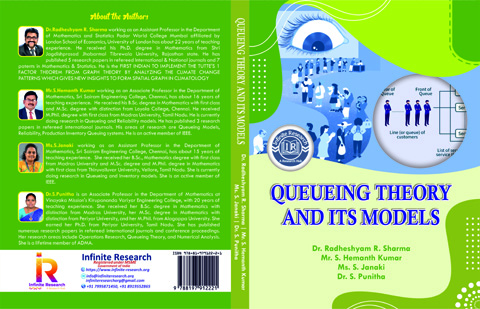
Authors: Dr. Radheshyam R. Sharma, Mr. S. Hemanth Kumar, Ms. S. Janaki, Dr. S. Punitha
| Product Price | ₹850.00 | ||
Click to add this item to cart. | |||
| Product Shipping |
|
Book Description
Queueing theory, a mathematical study of waiting lines or queues, has emerged as a vital tool in understanding and optimizing the performance of systems involving waiting times and congestion. The discipline finds its applications in a plethora of fields including telecommunications, traffic engineering, computing, manufacturing, and service industries, among others. This book, “Queueing Theory and its Models ,” aims to provide a comprehensive introduction to the fundamental concepts and applications of queueing theory. The motivation behind writing this book stems from a profound recognition of the significance of queueing theory in both academic and practical realms. Despite its importance, the subject can often seem daunting to students and practitioners due to its mathematical rigor and abstract nature. Our goal is to demystify queueing theory and present it in an accessible and engaging manner. Structure and Content This book is structured to guide the reader from basic principles to more advanced topics, ensuring a gradual and coherent learning experience. The initial chapters focus on the foundational concepts of queueing theory, including the birth-death process, Markov chains, and the Poisson process. These foundational topics are essential for understanding the behavior of queueing systems and serve as the building blocks for more complex analyses. Subsequent chapters delve into specific types of queueing models, such as the M/M/1, M/M/c, and M/G/1 queues. We explore their characteristics, analyze their performance measures, and discuss various methods for solving these models. Real-world examples and case studies are integrated throughout the text to illustrate the practical applications of queueing theory and to reinforce theoretical concepts. Audience and Prerequisites “Queueing Theory and its Models ” is designed for students, researchers, and professionals who are new to the field of queueing theory. While a basic understanding of probability and statistics is beneficial, we have endeavored to keep the prerequisites to a minimum. Each chapter builds upon the previous one, allowing readers to develop their knowledge progressively. Additionally, numerous exercises and problems are included to provide hands-on experience and to facilitate deeper understanding. Teaching and Learning Resources To support both instructors and learners, we have included a variety of supplementary materials. These resources include lecture slides, solution manuals, and simulation tools, which are available on the companion website. We encourage readers to make use of these resources to enhance their learning experience and to gain practical insights into the application of queueing theory.


