

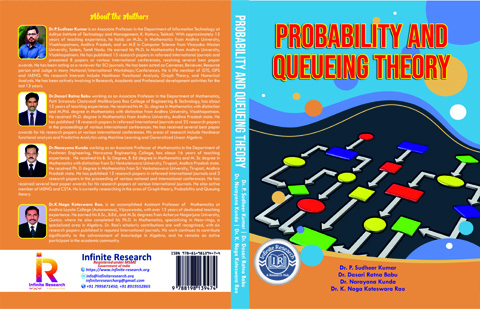
ISBN: 978-81-981394-7-4
Authors: Dr. P. Sudheer Kumar, Dr. Dasari Ratna Babu, Dr. Narayana Kunda, Dr. K. Naga Koteswara Rao
| Product Price | ₹950.00 | ||
Click to add this item to cart. | |||
| Product Shipping |
|
Book Description
The study of Probability and Queueing Theory occupies a foundational role in understanding and modeling the behavior of complex systems, especially in fields like telecommunications, operations research, computer science, and industrial engineering. Whether we are analyzing the arrival and service rates in a network, modeling customer service processes, or optimizing waiting times in a system, these mathematical frameworks provide us with the tools to make informed decisions, optimize processes, and predict future outcomes. This book, “Probability and Queueing Theory,” is a collaborative work by multiple authors who bring together a wealth of expertise in probability theory, stochastic processes, and queueing models. Each chapter in this book has been designed to cater to students, professionals, and researchers who seek a comprehensive understanding of these topics, bridging the gap between theory and practical application. The initial chapters provide readers with a solid foundation in probability theory, reviewing key concepts such as random variables, distributions, and stochastic processes. This theoretical groundwork is essential to understand how randomness governs real-world systems. We then transition to more specialized areas of queueing theory, where we examine various models of queues, including single-server and multiserver systems, priority queues, and Markovian models. These models are instrumental in a wide range of applications, from data traffic in telecommunications to service operations in healthcare and retail. Incorporating both classical and contemporary topics, the book delves into the mathematical formulations of queueing models, discusses solution techniques (such as generating functions, matrix-analytic methods, and simulation), and explores real-world applications. Each author contributes unique perspectives and insights based on their specialized knowledge, ensuring that readers are exposed to both the depth and breadth of the subject. We believe that the interdisciplinary approach adopted in this book will help students and practitioners not only grasp the core principles but also apply them in diverse and evolving domains. The inclusion of solved examples, exercises, and case studies allows readers to practice their skills and solidify their understanding of key concepts. We would like to extend our gratitude to all the contributors, whose collaboration has made this comprehensive work possible. We also thank our readers for their interest in this subject. Our hope is that this book serves as a valuable resource and helps you develop a deeper appreciation for the powerful role that probability and queueing theory play in modern-day systems analysis and optimization. We wish you the best in your journey of learning and discovery in the fascinating world of Probability and Queueing Theory.


